27 April 2008


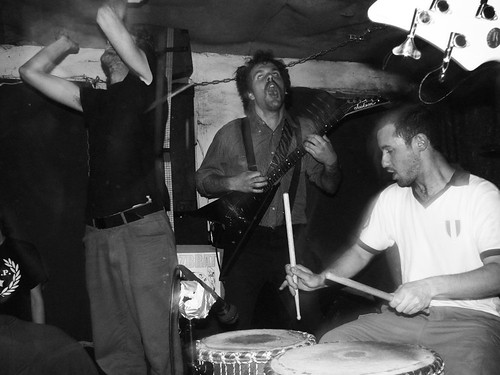
It's been over a week since I came back from Bad Berka (close to Weimar) for two days working with Cultures Interactive. It was intense there, and even more so after coming back to Berlin. My friends from Rome came to play in Berlin with their band Mithra, and it was such an amazing concert. Goes in my top 10 for sure*. It is great that they are my friends and that these friends produce such great music. They keep evolving and trying out new stuff and that is what I like a lot in bands, not sticking to the same old stuff. They brought out a new CD which is great, they play with a percussionist who hits the djembe Senegalese style (which I came to like, to my own surprise); I hope they will soon put one of the new songs on their site for everyone to hear!

With all these Italians coming to Berlin, even a bottle of Chin8 Neri magically popped up. Chinotto is very hard to find in Berlin and even if, it is the Pellegrino brand, which is nothing compared to the real bitterness and full taste that Chin8 Neri offers. Drinking this mix of chinotto citrus fruit extract and herbs, I get launched back at hot afternoon lunches in Rome, accompanied by good food. And there it stands, the rare bottle, during lunch time with good food and friends, on one of the first spring days on my roof! (The bottle has a new design ((here the old design)) and some voices say also the taste changed. I think it looks stylish and tastes the same. Any opinions on this?)

The Romans now unfortunately have left and with their warm presence also the group-excursions into Berlin's nightlife...Which is slightly better for my health and my productivity...More time to reflect when the choice is not between Kreuzburger or Aki Tatsu, but between writing a blog and going to sleep.


Back to BAD Berka, which really does deserve its first name... Intense it was, these two days we spent with the Klosterschule students. Without going into too many details (these on request), I can say that there are some people there who do not share my and the project's tolerant and democratic opinions, and are willing to act on that...

Therefore, lunch break on the first day was mainly spent with checking out some right wing stupids who tried to make their way into the school, causing panic amongst the students. Poor kids, so young, already scared about getting beaten up because of alleged 'political' opinions such as wearing band shirts....But as things had calmed down a little, I made my way into the class room where I held my workshop on Gefundenes Fressen, which is where also school lunch was served. Apparently, this was only for to the young kids. The two 'ovens' were situated in what was really just an ordinary class room. The woman that served it had the task of getting the boxes out and opening them for the kids. I did not get a chance to see what was actually in them, as I had some other things to do (eating lunch myself: bread and spread and an apple, bought by my colleague Nico, thanks for that!). Too bad I did not have time or focus to investigate about this way of serving food at a school.


I did find some other funny things on this school. This picture goes into the category 'pictures that frighten me'.** It was pinned on a wall in a classroom.

Then this sign was above the toilets in the hallway, i think it looks cool!

After work, we ate our „big meals“ in the restaurant in our hotel: very mediocre Greek (!) food and quite expensive....In a small town like Bad Berka, of course, options are limited. There are about 3 places where you could eat food more than just a snack. We ate a couple of times in a place which was not bad at all – it has a quite extensive vegetarian menu – the Ratsstuben in the centre. Well, we did go in, but never got our food!! This due to the fact that we chose to stand behind our colleague when she was threatened by right wing stupids just outside the door – the owner of the place 'didn't want anything to do with that' and pleased us to leave. Nice way to keep your customers happy!***

The next day we spent in Kranichfeld, to put up the Open Space in the sporthall of the school there. This sporthall was not our first choice, but the bad people again decided we could not be at the place where we originally intended to go.

It was very cold in Kranichfeld, and it reminded me of the days in November we spent there. It felt as if the weather had not changed since then; grey sky, a wet cold creeping into my bones, foggy...Remember the potatoes with the radiant sauce taken in this school? This time, no such food for us, since the canteen was only open to students this day. After a long day of work and surviving on bread brought from breakfast, we ended up in Blankenhain. We had to take care of our van at the Volkswagen garage there, because mysterically, a screw had found its way into one of the tires.... All restaurants close between 13.00 and 17.00 in small German towns, which is exactly the time we finish working and want to eat. After making a small closed restaurant odyssee in Blankenhain, we humbly ended up eating our supermarkt-bought lunch on the supermarkt parking lot....

I was more than happy to be back in Berlin and to have a choice of where to eat...Yet realizing that I find myself in the luxurious position to do this, whereas the nice kids I worked with are stuck in that BAD place. Hope the project can contribute to make their lives a little better....

Conclusion: no food for us on the schools, getting kicked out of a restaurant, eating supermarket lunch sitting on a parking place....I wonder if things will become any worse this year! Too bad the next time to find this out will only be in June.


* Also ranking: Trial in Budapest in 2005, Catharsis in Poortgebouw Rotterdam 2001, Zegota in De Vliegende Hond Utrecht 2003, By the Grace of God in Volta Amsterdam 1997, Explosions in the Sky in Paradiso Amsterdam 2007, Yage in Acu Utrecht ????, Highscore in Baracke Münster 2004, Tragedy in Köpi Berlin in 2003 and Betercore in Leiden ????


** The picture that made me make up this category I found in Marnitz. It was painted on the wall in the youth hostel we stayed at. Despite the bright neon light shining on it, it freaked me out....

*** Schlechte Werbung nochmal auf Deutsch: der Inhaber von dem Gasthaus Ratsstuben in Bad Berka hatte uns dringend gebeten, den Raum zu verlassen, nachdem unsere Kollegin beim Telefonieren vor der Tür von Naaazis bedroht wurde und wir sie verteidigen wollten. Seine Worte: 'Mit sowas will ich nichts zu tun haben'. Wir wurden also rausgeschickt, als wir uns in einer gefährlichen Situation befunden, die definitiv nicht von uns verursacht wurde. Super, so zeigt man Gastfreundschaft und Zivilcourage! Leider war das Wort Zivilcourage in Bad Berka nicht nur an dieser einen Stelle unbekannt, sondern scheint es ein weitverbreitetes Phänomen zu sein , dass die Menschen in Bad Berka lieber die Problematik von sich weisen und Veranstaltungen gegen Rechtsextremismus nicht zulassen, Treffen verhindern und generell kein offenes Bekenntnis gegen Nazis ablegen, weil sie alle davon ausgehen, dass es "doch lieber die Anderen machen sollen" und dass man eigentlich mal dem gesamten Ort eine Schulung in Zivilcourage verpassen müsste.

29 March 2008

Having started the school food project, I was really enthusiastic and I could not wait to leave for Marnitz to see what would be waiting for me there, food-wise.

Getting to Parchim (where we were staying two nights) was a small disaster: we left from Berlin at 19.00 for a 2 hour drive. We had just left Berlin as we discovered one of the front lights of the rental van was not working. We stopped and waited 2 hours at the gas station for "the angels of the road" (!), the ADAC, to help us. We saw the clock ticking the hours of sleep away....(had to get up at 6 the next morning). Finally we reached Parchim shortly before 23.00. A local pizza place was convinced to still make pizzas for us and we arrived at our rooms, with incredible hunger and 8 boxes with pizza, at 23.30....The pizzas smelled supergood, but as we opened our boxes they revealed the thing that was gonna plague us in the night....All different pizzas smelled, looked and tasted the same. And that was not good. In bed, my body could not really decide between sleeping or digesting, so it did neither. Here is how it looked like the next day:


The next day I realized I did not go there only to make a project about food, but to also actually work for the project. In this case, work meant a lot of work and stress and no time to care about food at the school. I was busy preparing and giving my workshop and on the second day I was busy organizing the Open Space method. I only ate what I brought to the school from breakfast (bread rolls) in our cosy place to stay, which looked like this from outside (we were staying were the light is burning):


My colleagues did find some time to eat food sold at the school:

What Mario and Menze are eating (Thomas also seems to eat the bread rolls from breakfast) is the vegetarian version of this:

The picture comes from a project I stumbled upon today, "Werbung gegen Realität". The artist bought 100 products from German supermarkets and made pictures of the actual product, to compare them with the picture on the package. It made me think if I take it for granted that there is such incongruency that advertisement creates. I know the picture on the package is not corresponding with the actual product, yet still I buy these products.


21 March 2008

School Food I: introduction

Next week, the new season of the project I work for, Cultures Interactive, is going to start for me. It means I will prepare a workshop about 'food', called Gefundenes Fressen, grab all the things I need, put them in a van and drive into the German province.
There, I will spend two days on a school, trying to educate young Germans about food in a broad sense. I will make them think about the things they eat every day, thereby discussing such themes as: what does "taste" mean and how is it cultivated? Where does my food come from? Who prepares it? Which claims are made on packages and are they true? We will not only talk, but also try out different things, with as most popular item the blind testing of different tomato soups according to self-set criteria. Also, they will cook soup themselves; it might be it is the first time they cook at all, or they can use their cooking skills in teaching the others.

The project is aiming for a long-term change in the region, seen from the perspective of the school kids we work with. We ask them for their needs and let them work on it on their own initiative. For instance, if a group is formed with an expressed interest in things food-related, I meet them once in a while and support them where they need, be it with additional workshops, talking to 'important adults' or making general arrangements.

The idea for this workshop, which I did twice so far, came from experience and of course my usual interest in food. The experience I gathered while traveling schools in Germany and seeing what the children eat in their breaks. From the Girl Power workshops I mainly provided so far, came stories about dieting: many young girls told about their diets, whereas, to my opinion, dieting for them is absolutely unnecessary for a number of reasons - first and foremost, bodies that young still are growing and need nutritients, yet ideals about the ideal body tell the girls otherwise. I noticed they went often into dieting without background about nutrition - and think that eating 'just' a candybar in breaks is a good way to lose weight. Often they seemed to have no idea about food or at least have no critical stance towards it.

Experiences thus came from the classroom but also from outside of it. On the days our team spends on a school and the village it is in, we find ourselves fully immersed in the local food culture. In our short breaks, we eat whatever the school offers us (but I also always take care to bring emergency stuff in case the school didn't think about us, something I never take for granted). And often, this means we eat in the school mensa where we eat the same food as the school kids. And we eat our dinners in the restaurants in the village. This provides an excellent insight in German food culture, and I am always tempted to document it.

And so I will, here. This is a "best of" of last year. I made pictures of food we were served at different schools in Germany.

My favorite picture of last year was of the one thing I could not eat. You see, working from 7.30 in the morning until 13.00 in the afternoon without a break makes a bit hungry. So mostly everything which is offered, I eat. Except from this thing, which was served to me on a school in Halle-Neustadt. It is called Germknödel mit Vanillesauce. It is supposed to be cooked dough with a sweet filling, accompanied by vanilla sauce. This particular exemplar proved to be very chewy, with a slimy, lukewarm, way too sweet sauce. I took one bite and chose to stay hungry. (Also in the knowledge that in Halle there is one of the best vegetarian fast food places I've come across.)
The Thing "germinating" in all its slimy g(l)ory:


And in all its radiating innocence:
That was Halle. Radiating sauce seems to be a common feature in German school mensas, as proved Kranichfeld. This picture from the school there also shows the care for vegetarians which I often encounter in such places (on a school somewhere in Mecklenburg-Vorpommern, there was no vegetarian food whatsoever, so I chose to eat the poor option, i.e. my emergency bread with spread. I sat in the mensa and was told to leave, as only the food sold there was allowed to be eaten).

Yes, Germans like potatoes.
Then, I can't remember where this was:
But it made my colleagues have their battle between hunger and taste:

Sometimes, schools are so nice to prepare breakfast for us and this can be really surprisingly good. There is care and love in it. And yes, they like bread and wurst, and no, I am not always sarcastic. I have tasted many bread rolls (Brötchen, or Schrippen in Berlin) and my favorite are the ones from Thüringen. This was in Grabow, Mecklenburg-Vorpommern (and there was a lot more on the table!).

Sometimes, I do have some free time to walk around and explore the little villages we are often in. I discovered that Germany has many idyllic and cute towns which I would never go to otherwise, so I am happy I have this possibility. Trying the local food is interesting. I will conclude with a picture made in the beautiful Ludwigslust, where I had a double espresso that was not too bad (I am spoiled when it comes to coffee, and hotels we stay in hardly ever provide the strong stuff I grew used to), before exploring the supermarket, another thing I love to do.
So this will be a start for the project that has been in my head since a while. To be continued soon!

09 March 2008

Art

On a recent visit to the Netherlands and with that naturally my parents, I made a trip with my father to collect two of his sculptures at a gallery in Brabant. Two hours of busy Dutch highway brought us to a small village on the Maas river which was beautiful in all its Dutch typicalities: small houses built from the red brick that I've become to miss so much. The gallery was situated in the main street and appeared closed. Some minutes later we were let in and were offered coffee. My father talked business and I looked around in the one room.


(one of the sculptures my father, Jan Pater, made)

Galleries have always given me the impression of a kind of sanctuary, rooms in which a special behavior was asked for. Churches for art. "This is Art, this has to be Appreciated in Silence and Solemnity." Slow steps from one work to another in upper concentration. Festive vernissages seem to serve the purpose of allowing and thereby evicting the last laughter, the excess before the silence is started.

I had never gotten a 'behind the screens of an art gallery', and my first experience was a revelation. I came to frown as soon as I made my entrance. On one of the sculptures there was a jacket hanging. It confused me: was the jacket part of the work of art? The size of the jacket and the sweating gallery man in his shirt told me otherwise. The gallery man and my father were carrying the rather heavy sculptures into the car, an activity which made the gallery man -who would best be described by some euphemisms- sweat, upon which he must have taken his jacket off. A gallery is not a place which has hooks for jackets, he took the most convenient object closeby. Now the art had become an ordinary coat hanger and I felt on a secret mission, looking for other signs of gallery blasphemy. Soon I found another indication: in the yard, where some more sculptures were exposed, lay a carefully placed piece of shit on the little white stones. There were some ambiguities in it which any artist would be jealous of: art or need? Sign of approval or disapproval? This time, two bowls on the floor in the kitchen made the revelation. To complete my search, a third transcendence of gallery standards I found when behaving like a good daughter, chitchatting with both gentlemen, sitting on the antique sofa. The sculpture next to it was demystified by putting a recharging mobile phone on it; we all know mobile phones are unworthy to be put on the floor to gain new energies and thus we should use the nearest object to save them from such unworthiness.


Seeing all this, I felt like when watching Benjamin in the final scene of The Graduate, swinging the big cross to block the church doors through which he escaped with his beloved Eileen. Yes, dramatic, but isn't art supposed to be?

21 February 2008

nothingness

i am planning to travel to kazachstan next year. my friend margarethe will go there and it seems like an exciting country, even though i do not know much about it. i just know there are endless savannahs (steppen), i.e. landscapes with a lot of nothing. i learned to love this emptiness in abruzzo last year, on the campo imperatore and i want to experience a lot more. (picture: campo imperatore)


this morning i found that NABU (german nature protection organization) has a project there to protect the almost extinct saiga antilope. now i really want to go there, look at this:


what a beautiful animal.

i love foxes. they seem the perfect mix between a cat and a dog. i like the way they walk and how i sometimes meet them in the streets of berlin. the corsac fox lives in central asia, hence also in kazachstan.

the one on this pic really looks like schmutzi, my cat (esp the facial bone structure and the hairs on the side of the face):


clear example of cat+dog=fox:


(pictures all not mine)

13 December 2007

(Yeah, it's in Dutch. I am complaining that it is not easy to get into the Dutch embassy. Not really worth translating.)

Ik zat ernaast. Ik dacht, als Nederlands staatsburger, verblijvend in het buitenland, heb ik ongetwijfeld een bijzondere status die mij de deuren zal doen openen die voor de Duitsers gesloten blijven. Naar aanleiding van deze zin moet u weten dat ik het hier heb over de nieuwe Nederlandse ambassade in Berlijn, ontworpen door Rem Koolhaas, in 2003 geopend werd, met uiteraard de nodige bombarie. Beschrijvingen over de architectuur van het gebouw laten zich gemakkelijk vinden op het internet. De potentiele bezoeker wordt gelokt met zinnen als: "In het glazen huis van de afdeling Cultuur is door het personeel een gezellige schemerlamp neergezet, die de bezoeker al vanuit de foyer beneden tegemoet straalt. Die bezoeker zelf is zowel van buiten als binnen te volgen op zijn avonturentocht onder beton, over en langs aluminium, hout en glas."* Een schemerlamp, wat een heerlijk gewilde kneuterigheid! En die avonturentocht!

Op de website van de ambassade wordt men zelfs uitgenodigd om kunst van eigen bodem te komen bekijken: "berlin_nl is een presentatie van werk van achttien uitzonderlijke, vaak jonge kunstenaars uit de Collectie Koninklijke KPN in de Nederlandse ambassade in Berlijn. Deze kunstenaars bewegen zich letterlijk en figuurlijk tussen Duitsland en Nederland: enkelen van hen wonen en werken in Berlijn, anderen hebben er in het verleden werk gemaakt. Die bijzondere relatie weerspiegelt zich in de onderwerpen die de werken aansnijden. Evenals het ambassadegebouw van Rem Koolhaas waarin zij worden getoond, reflecteren de werken op de hen omringende stad. De vragen die zij opwerpen zijn echter niet alleen van toepassing op het verleden van Berlijn, maar verwijzen ook naar de Nederlandse en Duitse actualiteit en Europese vraagstukken rond nationale identiteit, geschiedenis en de geldigheid van modernistische idealen. De Nederlandse ambassade en KPN willen die posities graag aan het publiek tonen." **

Let op het woord 'graag'. Het valt een beetje tegen: de goedgeluimde Nederlander die eens kunst van eigen bodem wil bekijken, moet dit uitje goed plannen. De Duitsers hadden het niet beter kunnen bedenken. Minstens 4 dagen vóór het geplande bezoek moet dit per mail aangekondigd worden (toegegeven, het aanmelden van bezoek klinkt best deftig), onder vermelding van diverse gegevens. Dan krijg je uiterlijk 2 spannende dagen later een mail of je mag komen of niet. Als er een manifestatie plaatsvindt in de foyer, gaat het feestje niet door. Het is vast erg rustig kunst kijken daar in de ambassade!

Ik was dus blij een enigszins belangrijke reden gevonden te hebben om de ambassade aan te doen: ik wil een identiteitskaart. Paspoort past niet in de portemonnee, en ik ben een brave burger met Ausweispflicht. Met afschuwelijke pasfoto's en een smak geld in de tas meldde ik me dus vol goede moed bij de ambassade. Een bus met toeristen reed er net langs, waardoor ik me ineens erg local voelde. De security man (een Duitser) vroeg wat ik kwam doen, en op mijn antwoord liep hij met me mee naar een deur aan de zijkant van het gebouw. Hij drukte op de knop om de deur te openen, met de mededeling "de deur opent zometeen". Inderdaad, en ik kwam terecht in een ruimte met twee loketten, een man die tevens nieuwe documenten aan wilde vragen en een lokettiste. Ik leverde mijn papieren, foto's en geld in, en stond alras weer buiten. Dat was alles. Eerlijk gezegd had ik een beetje meer verwacht: een schaal koekjes, een radiozender uit Hilversum, een hartverwarmend onthaal. Nee. De spreekwoordelijke en metaforische koektrommel bleef gesloten.

Mijn vriendin Nelleke werkt voor het Institut Néerlandais in Parijs. Daar hebben ze filmavonden, een bibliotheek, bezoeken van schrijvers, Sinterklaas die over de Seine vaart, enzovoort. Ik ben soms best jaloers.

Hier dus de ambassade, met waar de man staat het lokethokje waar ik vandaag was. Er zijn mooiere foto's, maar niet met blik op het lokethokje.

* van duitslandweb.de
** van niederlandeweb.de


07 December 2007

Ordnung on the plate

A short Google search brought me these definitions*:

Begriff: Sättigungsbeilage
Erklaerung: Etwas aus der Mode gekommener ostdeutscher Begriff für Beilagen zu einem Hauptgericht die 1.) billig sind und 2.) statt machen.

"Bei den klassischen Sättigungsbeilagen wie Reis, Nudeln und Kartoffeln kann man bedenkenlos zuschlagen, solange nicht dick Sauce darüber gegossen wurde."**

Sättigungsbeilage f filling vegetables, trimmings pl inf

I chose this word as the title for my blog because it sounds so German, and the meaning of it keeps amazing me. It assumes there is a hierarchy in sorts of food: there is a main course, something special, which goes together with the other, lower class foods, which are just there to fill your stomach for little money. It bases on the 'meat, potatoes, vegetable' diet which I also grew up on.

This word thus stands for the 'German' style of cooking and eating. Germans (sorry, I hate how generalizing this sounds) like everything mixed, much like the Dutch do. All dishes are served on the plate together: potatoes/rice/pasta, vegetables, salad, whatever source of protein, are all dished up on one plate. The Dutch famously mash everything together with a fork, a habit which is even granted with a specific verb: prakken! My Italian friends shudder with (not only) amazement when their precious pasta becomes plate-mates with anything else, and frankly speaking, I've learned from them to prefer it this way since I've grown a huge fan of Italian food (horribly cliché, but I don't care) or here rather, their 'order' of eating. Primo, then seconds, then salad, then whatever sweet, fruity, nutty or coffee-y follows. Segregation on the plate. For why would one put a hierarchy in foods if everything tastes good enough by itself?

* I wonder if there are any equivalents in other languages? Apparently 'trimmings' is the English translation, however, it does not seem to entirely fit (please correct me if I'm wrong).
** translations: Word: Sättigungsbeilage. Explanation: East-German notion, somewhat out of fashion, for side dishes to a main course which are 1.) cheap and 2.) are filling. / With the classic Sättigungsbeilagen like rice, noodles and potatoes one can dish up without thinking, as long as no sauce is put on them.

04 December 2007

There. I found a possibly cool and maybe even obscure title. I found a fitting quote to illustrate it and to demonstrate intellectuality and profoundness (hm, a lowbrow cultural element as a postmodern pendant is still lacking; update will follow). Picture fitting to the theme: check. I decided not to brag about the choice for English as the elected language to write in over some other languages. I put some information in the right margin to complete the blog. And with this introduction, I successfully blogged for the first time (well, except some practices on myspace). And of course, a good introduction needs a welcome to the reader: hello! Veel plezier!